EVA photovoltaic packaging film: How to protect the "invisible shield" of solar modules for 25 years?
- 2026-06-12
- Fulian Professional Manufacturer of EVA Film
- 2945
Have you ever wondered why those photovoltaic panels standing on rooftops and in the desert can withstand the test of the scorching sun, heavy rain, and wind and snow all year round? The secret is hidden in the thin layer of EVA film between the two panes of glass. This material, which is less than 1 mm thick, is the key to ensuring the 25-year lifespan of photovoltaic modules.
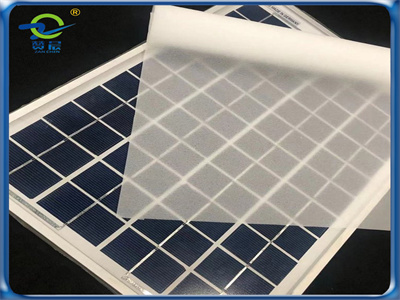
"Heart Guardian" of Photovoltaic Modules"
EVA film, the full name of ethylene-vinyl acetate copolymer film, is the core material for photovoltaic module packaging. It is like the cheese layer in a sandwich, tightly bonding fragile battery sheets with tempered glass and backplanes. The national standard GB/T29848-2018 has strict regulations on its performance. It currently occupies more than 70% of the photovoltaic film market.
The particularity of this material is that its vinyl acetate content is controlled between 28% and 33%, giving it both high transparency (91.7% light transmittance) and strong adhesion. During the lamination process, the EVA film will undergo a cross-linking reaction to form a three-dimensional network structure. This transformation changes it from a thermoplastic material to a thermosetting material, thereby obtaining excellent weather resistance.
The science behind performance advantages
The outstanding performance of EVA film comes from its multiple protective mechanisms. First, it can filter harmful ultraviolet rays and protect the cells from light decay. Secondly, its volume resistivity is as high as 7.19×10¹⁶Ω·cm, which effectively prevents current leakage. What is even more commendable is its "self-healing" property. When micro-cracks occur in components due to thermal expansion and contraction, EVA's elasticity can compensate for the stress and avoid the expansion of defects.
In terms of waterproof performance, the water vapor transmission rate of high-quality EVA film can be controlled within 7.32g/(m²·24h), which is equivalent to putting a waterproof jacket on the battery cell. PetroChina is building an EVA production line with an annual output of 300,000 tons in Qinzhou, Guangxi. It is expected to be put into operation in 2027, which will significantly increase the supply capacity of domestic high-end EVA.
Challenges and breakthroughs in technology iteration
The biggest challenge faced by traditional EVA film is the potential-induced decay (PID) phenomenon. When the acetic acid produced by the hydrolysis of EVA combines with the sodium ions in the glass, it may cause the module power to decrease by up to 50%. Industry leading companies such as Changzhou Parkson have successfully controlled power attenuation within 1.68% through innovative formulas and the introduction of alkaline organic matter into the EVA matrix.
Another solution is double-layer co-extrusion technology, such as the composite film developed by Swick. The upper layer uses ethylene acrylic acid copolymer, and the lower layer maintains the traditional EVA characteristics, which ensures anti-PID performance without affecting the light transmittance. These innovations enable EVA to maintain technological vitality in the competition of new POE/EPE materials.
Value choice in the era of parity
Although it only accounts for 3%-4% of the component cost, the performance of the EVA film directly affects the LCOE (levelized cost of electricity) of the power generation system. In the new era of full photovoltaic parity, EVA film is continuing to reduce costs through process improvements. Guangxi Petrochemical's new installations will adopt a more energy-saving tubular production process.
From the severe cold of the Qinghai-Tibet Plateau to the high humidity of Hainan Island, from the windy sand in the northwest to the salt spray on the coast, China's vast climate environment provides the most stringent testing ground for EVA film. It is the silent protection of this material that allows every ray of sunlight to be converted into clean electricity and light up thousands of households. When we install photovoltaic systems on the roof, we might as well be grateful for this invisible "invisible shield".
Related Information
-
Anti-aging properties of eva glass film
-
What fields is EVA hot melt adhesive film suitable for?
-
EVA玻璃夹胶膜的重量是多少
-
What is the composite process of TPU composite film?
-
In what areas are EVA glass laminated films mainly used?
-
How to use photovoltaic EVA film in solar panel packaging